How AI Singer Technology Works: The Science Behind Digital Voices
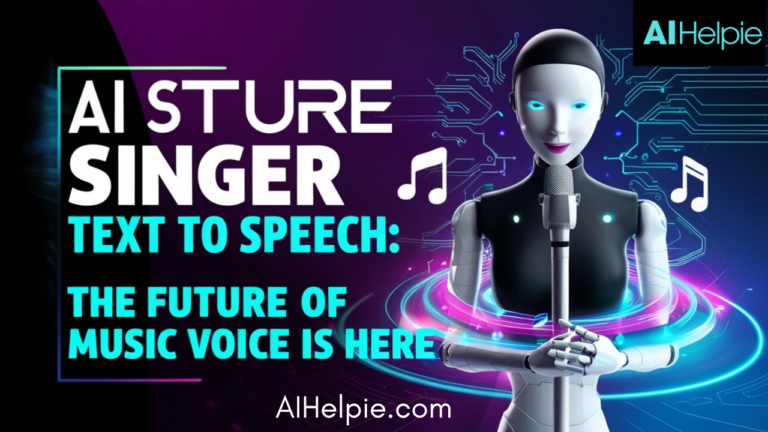
Imagine—you’re listening to a perfect cover of your favorite song on YouTube. Every note is perfect, the vibrato is superb, the breath flow and pitch control are so precise that it sounds like a real singer is singing. But then you realize… there’s no human singer there at all. Welcome to the exciting world of AI Singer Technology.
And believe me, this isn’t just some Auto-Tune trick. We’re talking about deep learning models, neural vocoders, and advanced synthesis frameworks that transform raw data into a lifelike voice.
What is AI Singer Technology?
Basically, AI Singer Technology is a combination of machine learning, digital signal processing (DSP), and neural synthesis models to create realistic singing voices.
Instead of recording a song in a recording studio, engineers train algorithms using human vocal datasets—which include millions of notes, pitches, and emotional expressions. The result? A model that can copy a song’s style
The Core Tech- Nerd Mode: ON
So, how does AI do all this? Let’s break it down at a technical level:
1. Data Collection & Preprocessing
AI singers are trained on massive vocal datasets. This includes a cappella tracks, multi-language samples, and phoneme-aligned lyrics. During preprocessing, noise is removed and pitch normalized so that the AI learns only patterns, not mistakes.
2. Feature Extraction
The system extracts Mel spectrograms (visual representations of sound) and pitch contours from the recordings. This forms the AI’s “input language.“
3. Deep Learning Models
- Tacotron 2 (Google): Maps text/lyrics to Mel spectrograms.
- WaveNet (DeepMind): Neural vocoder that converts spectrograms into natural-sounding waveforms.
- Diffusion Models: New technology that generates ultra-realistic songs by refining voices step-by-step (similar to AI images).
- RNNs & Transformers: Capture temporal dependencies in music, such as rhythm and phrasing.
4. Voice Synthesis Engines
Here are some popular tools that make this magic possible:
- Vocaloid (Yamaha): One of the earliest singing synthesizers.
- Synthesizer V Studio: Advanced engine that provides AI-driven realism.
- OpenAI Jukebox: Neural net that can generate entire songs (vocals + instruments).
- DiffSinger (Microsoft Research): A diffusion model designed for singing synthesis.
5. Fine-Tuning & Style Transfer
Let’s say you want an AI to sing like Adele, but in Spanish. Transfer learning + style tokens make this possible. AI can adapt a singer’s tone to another language or genre.
Why this technology feels like magic?
- Custom Voices: Indie artists can “hire” synthetic voices without paying session singers.
- Voice Preservation: Artists can permanently preserve a digital signature of their voice. (Hello, AI Freddie Mercury!)
- Language Flexibility: AI can sing an English ballad from a Japanese vocal dataset.
- Personalization: Imagine Spotify creating a song in your own voice from your text prompts.
This isn’t sci-fi anymore—we’re moving towards it.
Challenges and Ethical Dilemmas
With such powerful technology comes some questions:
Copyright Issues: If AI could sing with a voice like Taylor Swift, who would own it?
Deepfake Concerns: Voices could be used in scams (already happening with speech AI).
Cultural Authenticity: Can AI capture the spirit of ghazal or gospel music, or will there always be something “missing”?
FAQs (How AI Singer Technology Works)
Q1. What is the difference between AI singing and speech synthesis?
A. Speech synthesis focuses on clarity and intelligibility, while singing synthesis requires modeling pitch, rhythm, vibrato, and expressiveness.
Q2. Which AI software is best for creating songs?
A. Vocaloid, Synthesizer V, OpenAI Jukebox, and DiffSinger are popular options for high-fidelity results.
Q3. Can AI truly write and sing songs?
A. Yes. Systems like OpenAI Jukebox can create entire compositions—lyrics, melody, and singing—all in one.
Q4. Is this technology available to hobbyists?
A. Absolutely. Synthesizer V Basic (the free version) is the place to start.
Conclusion
So, how does AI Singer technology work? Simply put: it listens, learns, and then sings—thanks to deep neural networks, vocoders, and AI-powered synthesis engines. Will it replace human singers? Probably not. But it will democratize music creation, forever preserving legendary voices and opening up new frontiers of creativity. And yes—the next time a song on TikTok sounds too perfect, don’t be surprised if that “singer” is sitting inside a GPU.