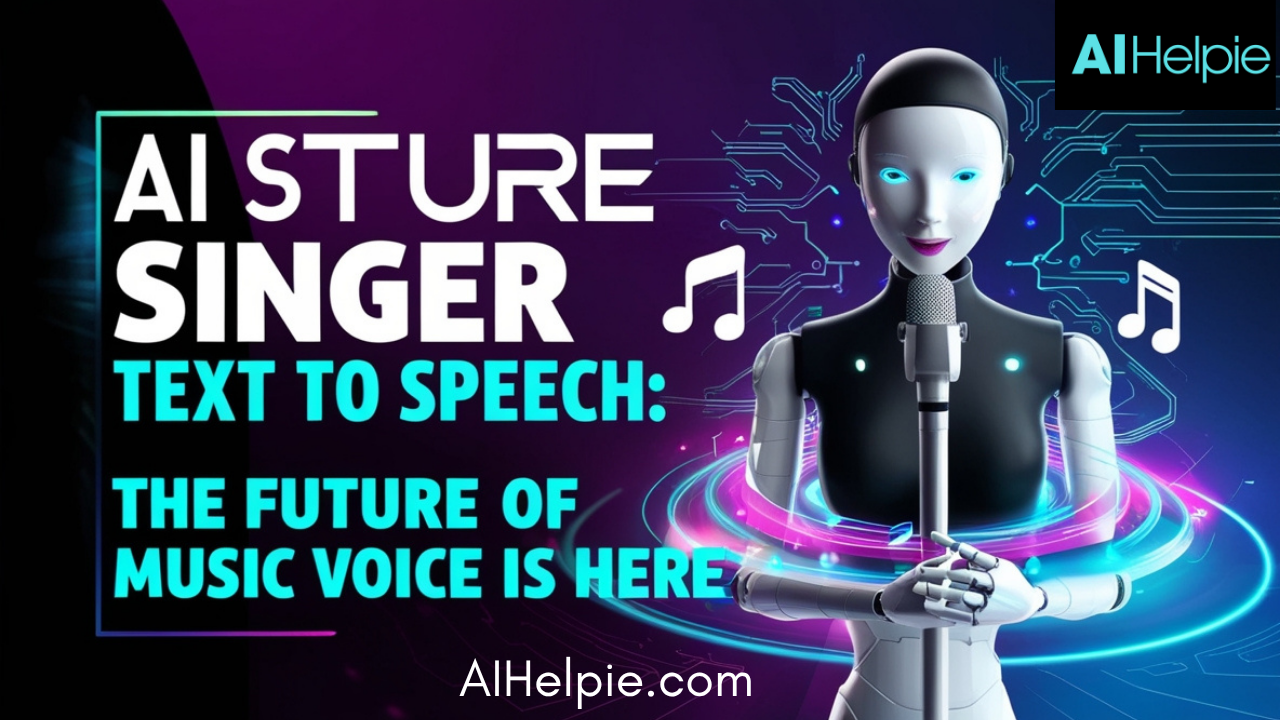
AI Singer Text to Speech: The Future of Music Voice is Here
Ever wished your laptop could sing your favorite song in perfect pitch? Sounds like something out of a sci-fi movie, doesn’t it? But meet AI Singer Text to Speech, where technology doesn’t just speak, it sings.
It’s not just about Siri singing “Happy Birthday”. The real game is deep learning models, neural vocoders, and advanced text-to-speech systems that transform simple lyrics into authentic and emotional singing.
Well, if you think this technology is years away—you’re late to the party.
What is AI Singer Text to Speech
In simple terms, AI Singer Text to Speech is a combination of natural language processing (NLP), deep neural networks, and speech synthesis. While regular TTS (Text-to-Speech) focuses solely on clear and understandable speech, AI Singer systems are trained to understand and generate pitch, rhythm, vibrato, and emotional tone.
Like the difference between your GPS voice saying “Turn Left” and Freddie Mercury singing “We Will Rock You.” Both are spoken, but one sends a chill down your spine.
How does AI Singer Text-to-Speech work?
Frankly, the process is mind-boggling, but the logic is quite clear. Here’s the 4-step formula
- Lyrics Input – You enter text (be it song lyrics, poems, or Twitter posts).
- Phoneme Conversion – The system converts the text into phonemes (small sound units).
- Deep Learning Models – Models like Tacotron 2 (Google) and DiffSinger (Microsoft Research) map the text to the melody.
- Neural Vocoders – Models like WaveNet (DeepMind) create smooth and natural singing audio.
By the way, if you’ve ever used Google Text-to-Speech or Microsoft Azure Speech Studio, you know that’s the basic version. AI Singer is their talented musical cousin.
Popular AI Singer Text-to-Speech Tools
Here are some of the top players making waves in the music world
Vocaloid (Yamaha): The OG of AI singing.
Synthesizer V Studio: Ultra-realistic voices and multilanguage support.
OpenAI Jukebox: A neural net that generates full songs (not just vocals).
DiffSinger: Diffusion model-based super-expressive singing.
Uberduck.ai: Where you can create custom AI raps and voices.
Fun fact: I first had my grocery list rapped Eminem-style on Uberduck. I laughed so hard listening to the “two tomatoes and a loaf of bread” rap that I held my stomach.
Why AI Singer TTS Sounds Like Magic
It’s not just for music geeks. This technology is democratizing music creation.
- For indie musicians: Can’t afford to hire a studio singer? AI is ready.
- For fans: Want to hear your favorite song in your own voice? Now it’s possible.
- For preservation: Legendary singers’ voices can be digitally immortalized. (Think, a new Kishore Kumar song from AI!)
- For accessibility: People who have lost their voices can sing again.
According to Stanford AI Research, these systems are also making cross-cultural collaboration easier with multilingual AI singing.
My First Experience with AI Singing
A friend sent me an AI cover of “Shape of You” on Synthesizer V Studio. I thought it would sound like a robot trapped in Auto-Tune. But no—the phrasing, the tone, the emotions were all so natural that I was stunned.
It wasn’t Ed Sheeran. But it wasn’t lifeless either. It was something new. And at that moment, I realized this wasn’t just technology, it was a way to redefine creativity.
FAQs
Q1. What’s the difference between AI TTS and AI Singer TTS?
AI TTS = clear and crisp spoken voice.
AI Singer TTS = also adds melody, rhythm, melody, and expression.
Q2. Can I create my own AI Singer?
Yes! You can easily try it with tools like Synthesizer V Basic (free) and Uberduck.ai.
Q3. Is it legal in commercial music?
It depends. Cloning a famous singer’s voice and using it publicly could lead to trouble. The Harvard Law Review has details on this.
Q4. Will AI singers replace humans?
Less likely. They won’t replace, but rather complement. Authentic emotions and live performances will always be unique.
Conclusion
So, AI Singer Text to Speech is essentially the art of teaching computers to sing—using neural networks, vocoders, and a little musical magic.Will it change music forever? Yes.
Will it kill human singers? No.
But it will certainly open up new avenues—from AI karaoke apps to personalized lullabies in your grandmother’s voice.The next time a song on TikTok sounds too perfect… be suspicious that it’s the GPU doing the hard work.